
Does This Sound Familiar?
You just bought a brand-new planner or opened a fresh digital calendar. You’re determined to get organized. You start filling in events, setting deadlines, and adding habits to track.
For the first few days, it feels great. You’re on top of everything!
But then… life happens. You miss a day. Then another.
Suddenly, you feel like a failure. The planner that was supposed to help is now a reminder of everything you didn’t do. So you stop using it altogether.
Why does this happen? Because rigid schedules don’t work for neurodivergent brains.
Why Traditional Planners Fail for ADHD & Neurodivergent Minds
Most planners are designed with neurotypical productivity hacks in mind, assuming:
✔ You’ll remember to check your planner daily
✔ You’ll consistently fill in and follow a rigid schedule
✔ You won’t get overwhelmed by structured layouts and deadlines
But ADHD brains work differently.
Here’s what actually happens when we try to use a strict planner:
🚫 Time Blindness: We underestimate or overestimate time, leading to missed deadlines.
🚫 Decision Paralysis: Sitting down to plan feels overwhelming … where do you even start?
🚫 Overcommitment Spiral: You feel like you need to track everything, so your planner fills up fast.
🚫 Streak Pressure: You miss a day → feel guilty → avoid your planner → stop using it altogether.
🚫 No Dopamine = No Motivation: Planners often lack immediate rewards, making them easy to forget.
So what’s the solution? Instead of forcing ourselves into a rigid system that wasn’t built for us, we need to build a flexible one.
The Secret to ADHD-Friendly Planning: Open-Ended Planners
What is an Open-Ended Planner?
An open-ended planner removes the pressure of tracking every single day. Instead, it focuses on:
✅ Task-based planning (instead of strict schedules)
✅ Flexible layouts (brain dumps, lists, Kanban boards, whiteboards)
✅ Progress tracking instead of streaks
This way, missing a day isn’t a failure—it’s just part of the process.
How to Plan Without Strict Schedules or Dates
1️⃣ Brain Dumps 🧠💭
Best for: Creative thinkers & chaotic minds
- Goal: Get all thoughts out of your head → organize later.
- Best tools: Bullet journals, sketchbooks, blank paper.
- Pro tip: Don’t overthink! Write, doodle, or scribble ideas freely. Then go back and highlight key points.
2️⃣ Whiteboards 📝📌
Best for: People who forget tasks easily
- Goal: Keep important reminders visible at all times.
- How to use: Create sections for lists, appointments, and notes.
- Pro tip: Place your whiteboard somewhere you walk past multiple times a day (kitchen, bathroom, office).
3️⃣ Kanban Boards 🎯🔄
Best for: People juggling multiple tasks at once
- Goal: Track tasks by progress instead of strict deadlines.
- How to use: Create columns: To-Do | In Progress | Done
- Pro tip: Drag-and-drop systems (Trello, Notion, ClickUp) provide dopamine boosts when moving tasks to “Done!”
Why Habit Trackers Often Fail (And How to Fix Them)
Traditional habit trackers are designed for consistency, but ADHD brains don’t always work like that.
🚫 They prioritize streaks over progress → One missed day = feeling like you failed.
🚫 They assume every day has equal energy levels → Some days, you can do everything; other days, even brushing your teeth is a win.
🛠 ADHD-Friendly Habit Tracking Alternatives
✅ 📊 Progress-Based Trackers
- Track how many times you complete a habit in a week, not daily.
- Example: Instead of “Exercise every day,” try “Move my body 5x this week.”
✅ 🎨 Visual Tracking Instead of Checkboxes
- Use colors or symbols instead of rigid checkboxes.
- Example: Highlight completed tasks in green, partial effort in yellow, and skipped days in blue.
✅ ⏳ Weekly (Not Daily) Habit Tracking
- Avoid feeling stuck in a “miss one day, give up completely” loop.
- Example: Track “read for 3 hours this week” instead of “read daily.”
✅ ⚖️ Allow Catch-Up Days
- Some days are hard. That’s okay!
- Example: If you miss your workout, add an extra walk another time instead of feeling guilty.
Final Thoughts: Make Planning Work for You
Neurodivergent and ADHD-friendly planning isn’t about forcing yourself into strict systems. It’s about creating tools that fit your brain.
✨ Let go of the idea that planners must be used daily.
✨ Find what works for you—whether it’s a bullet journal, a Kanban board, or sticky notes on your fridge.
✨ Make planning fun! Use colors, stickers, or rewards to stay motivated.
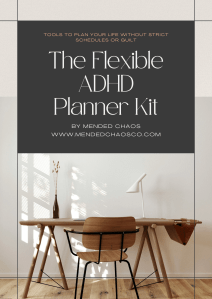
📥 Want a Free ADHD-Friendly Planner Template?
Download my Flexible ADHD Planner PDF below to get started!
📌 What’s your favorite way to plan? Drop a comment and let’s share strategies!




 Mended Chaos Co